
France's new Crypto-Law is a Kidnapper's Dream
 Mynymbox
- General
- April 9, 2026
France is about to make a catastrophic mistake. The country is preparing to pass legislation that would force anyone holding more than €5,000 in self-custodied cryptocurrency to declare those holdings to tax authorities.
On the surface, this sounds reasonable. Governments need tax revenue, and transparency is important. But the timing reveals a stunning disconnect from reality: France has just spent two years suffering an unprecedented wave of violent crypto-related crimes, many directly enabled by government negligence, and its response is to create an even larger centralized database of crypto holders for criminals to target.
This isn't just bad policy. It's a case study in how well-intentioned regulation can backfire spectacularly when divorced from the real-world consequences of data breaches.
The Crisis That Started Everything
To understand why this law is so dangerous, you need to know what France has experienced since 2024. The country became the global epicenter of cryptocurrency-related kidnappings and violent robberies. What security experts call "wrench attacks," where criminals use physical force to steal crypto assets. And those are just a few from many more.
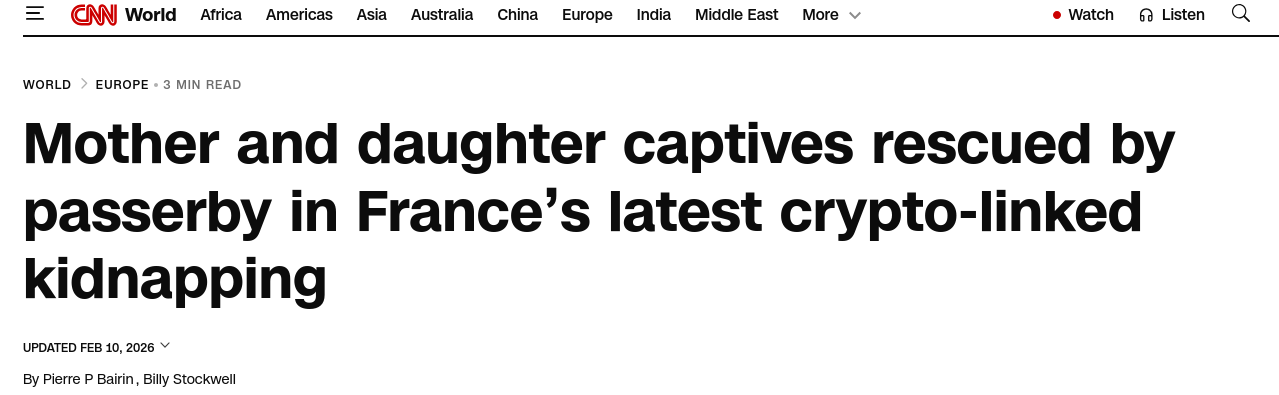
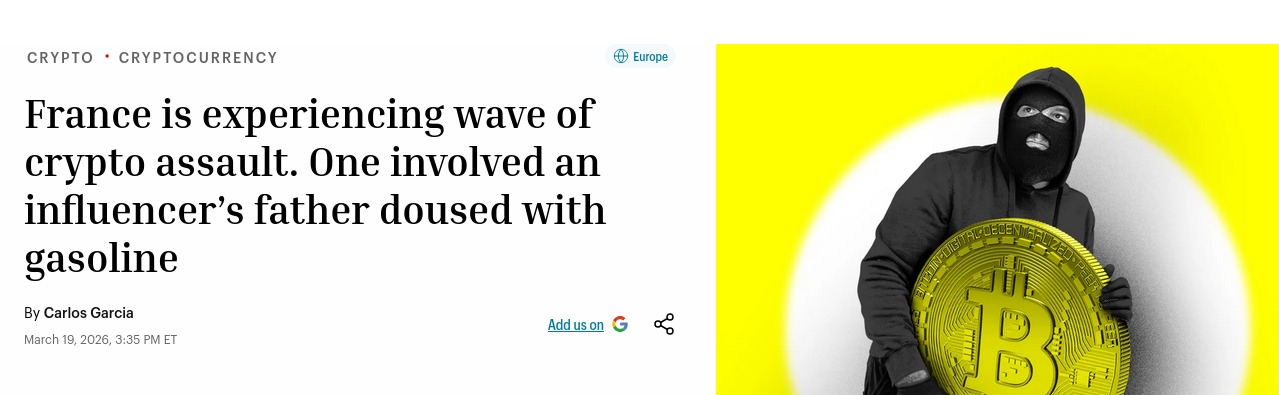
The numbers are staggering. In 2025, France accounted for 19 of 72 verified wrench attacks globally, more than double the United States. By early 2026, the situation had worsened. In just six weeks, 11 of 14 known global crypto attacks occurred in France. Kidnappers severed fingers in ransom schemes. David Balland, the co-founder of Ledger (one of the world's largest crypto hardware wallet companies), was abducted along with his partner. Binance France's CEO David Prinçay had armed men invade his home on February 12, 2026.
What makes this particularly disturbing is that many of these attacks weren't carried out by sophisticated criminal networks. Of 25 people charged in connection with these crimes, all were between ages 16 and 23. Six were minors. They were recruited on social media and paid as little as $10,000 by masterminds operating from outside France, primarily from Morocco. They were foot soldiers in a system that weaponized information about crypto holders to orchestrate high-value robberies.
The question everyone should be asking is: where did the criminals get the information to know who had crypto and where they lived? The answer is deeply unsettling.
How Government Negligence Created This Mess
In June 2025, French authorities arrested a 32-year-old woman named Ghalia C. who worked at the Bobigny tax office. Her crime was extraordinary in its brazenness: she used confidential government tax software called "Mira" to systematically search for cryptocurrency investors, then sold their personal information (including home addresses!) to criminal organizations. She received cash payments and Western Union transfers in exchange.
The buyers of this data weren't just abstract criminals. They used it to plan violent home invasions. In one documented case, three armed men assaulted a prison officer in his home based on information Ghalia provided. When arrested, Ghalia claimed she didn't know what the buyers would do with the data. Whether that was true or not, the damage was done.
But Ghalia C. wasn't the only problem. While she represented a spectacular breach of trust by an individual employee, other breaches revealed systemic vulnerabilities. In January 2026, a cryptocurrency tax platform called Waltio was hacked, exposing data on approximately 50,000 users, including email addresses, gains, losses, and year-end balances. Criminals claimed this data was directly linked to at least three kidnappings that netted $17.1 million in stolen crypto.
Ledger, the hardware wallet company, had its own crisis when a third-party payment processor called Global-e was compromised, exposing customer names and contact information. In May 2025, a database containing tax and personal information on over two million French taxpayers, including crypto holders, was discovered for sale on dark web forums.
This wasn't a series of isolated incidents. It was a pattern of institutional failure. France's government had demonstrated, repeatedly and conclusively, that it could not protect sensitive data about cryptocurrency holders. Criminals had proven they would use that data for violent crimes.
Then France's response was to pass a law creating an even larger centralized database of crypto holders.
The New Law and Its Logical Incoherence
The €5,000 declaration law, adopted by the National Assembly committee in December 2025 as part of Bill 1649AC, would require French citizens to annually declare the existence and value of any self-custodied cryptocurrency wallets holding more than €5,000. Self-custodied wallets are personal digital wallets like Ledger hardware wallets or MetaMask. The kind where individuals hold their own private keys rather than trusting a centralized exchange.
The government justifies this as necessary for tax compliance and to combat fraud. France's Court of Auditors and the Public Finance Committee recommended it. On paper, the rationale is straightforward: the government wants visibility into what citizens own so it can ensure they're paying appropriate taxes.
But here's the problem, and it's fundamental: the government has just proven it cannot keep this information safe.
Not only that, but the law creates perverse incentives. The government cannot actually verify that someone has a self-custodied wallet or validate the claimed value without access to the blockchain and blockchain addresses are pseudonymous. So the law relies entirely on voluntary compliance from citizens who are essentially incriminating themselves to a government that has demonstrated it cannot protect this information. Meanwhile, sophisticated criminals and tax evaders who don't declare anything face no increased risk, because enforcement against hidden wallets is impossible.
For legitimate citizens, the consequence is clear: register your crypto holdings with the state, knowing that state has repeatedly failed to protect sensitive financial data, and knowing that information about crypto holdings directly increases your risk of violent crime. For criminals and tax evaders, the law changes nothing. They simply don't declare, and the government cannot verify their holdings - whoops.

The Centralization Problem
This law exemplifies a fundamental security principle: centralization creates targets. Every database of sensitive information becomes a honeypot for criminals and foreign intelligence services. France has already demonstrated this vulnerability repeatedly.
The European Union's DAC8 directive, which took effect on January 1, 2026, made the problem worse. This directive requires crypto platforms to automatically report client identities, tax numbers, and portfolio balances to tax authorities across 48 countries. Now add France's proposed self-custody declaration law on top of that, and you've created overlapping centralized databases of cryptocurrency holders - all within a government that has shown it cannot protect them.
It's not theoretical that these databases will be breached again. Ghalia C. wasn't a one-time anomaly; she was enabled by a system where access to sensitive financial data was insufficiently monitored. Waltio wasn't targeted because it had particularly weak security; it was targeted because it contained valuable data. The dark web database wasn't discovered by accident; it was marketed to criminals as a commodity.
Each new database increases the probability that another breach will occur. Each breach creates new victims. And France's response to this foreseeable problem is to triple down on centralization.
Why Enforcement Will Fail Anyway
There's another dimension to this law's incompetence: it's essentially unenforceable in any meaningful way. The government cannot verify the existence of self-custodied wallets. If you claim you have no crypto, the government has no way to prove otherwise. That's the entire point of self-custody, is it not? The government cannot validate declared valuations. Crypto prices fluctuate constantly; is someone required to declare at the price on January 1st? The day they bought? The all-time high?
The law creates an illusion of enforcement without providing the tools for actual enforcement. Some citizens will dutifully declare their holdings out of good faith or fear of legal consequences. Others will not, and the government will have no mechanism to find them. Sophisticated tax evaders and criminals will ignore the law entirely. Meanwhile, compliant citizens have registered themselves as targets for the exact crimes that have been plaguing France.
This is enforcement theater: a law that looks like it does something without actually addressing the underlying problem. In fact, it makes the problem worse by creating a false sense of security while establishing new infrastructure for surveillance and data breaches.
The Political Reality
Despite all of this, the amendment has cross-party support in the French National Assembly. It's likely to pass because it appeals to legitimate government interests in tax compliance and fraud prevention. But it does so without seriously engaging with the elephant in the room: France cannot protect the information it already collects about crypto holders. Creating more centralized data won't solve tax evasion; it will just create more victims.
The government could pursue many alternative approaches. It could strengthen security and audit procedures for existing databases. It could focus enforcement on exchange-level data (which platforms like Kraken and Coinbase already report). It could invest in blockchain analysis to identify suspicious transaction patterns without forcing declaration of holdings. It could pursue the criminal networks operating from Morocco that are actually orchestrating these attacks.
Instead, it's choosing the path of least resistance: pass a law that appears to address the problem while actually making citizens less safe.
What This Reveals About Regulation
This situation illustrates a dangerous pattern in technology regulation. Regulators often respond to crises by expanding their own authority and data collection (what might be called "security theater through centralization"). It gives the appearance of control and action without actually solving the underlying problem. In fact, it frequently makes things worse by creating larger, more attractive targets for the very criminals the regulation was meant to stop.
The €5,000 declaration law will likely result in more French cryptocurrency holders being targeted by criminals, not fewer. It will not meaningfully increase tax compliance, because it's unenforceable against those who simply don't comply. And it will not address the core institutional failures that enabled Ghalia C., Waltio, and the dark web database to become weapons against innocent people.
France had an opportunity to learn from a crisis. Instead, it's creating the conditions for the next one.