
Privacy and AI Governance in 2026: Why “Consent” won’t save you from Surveillance
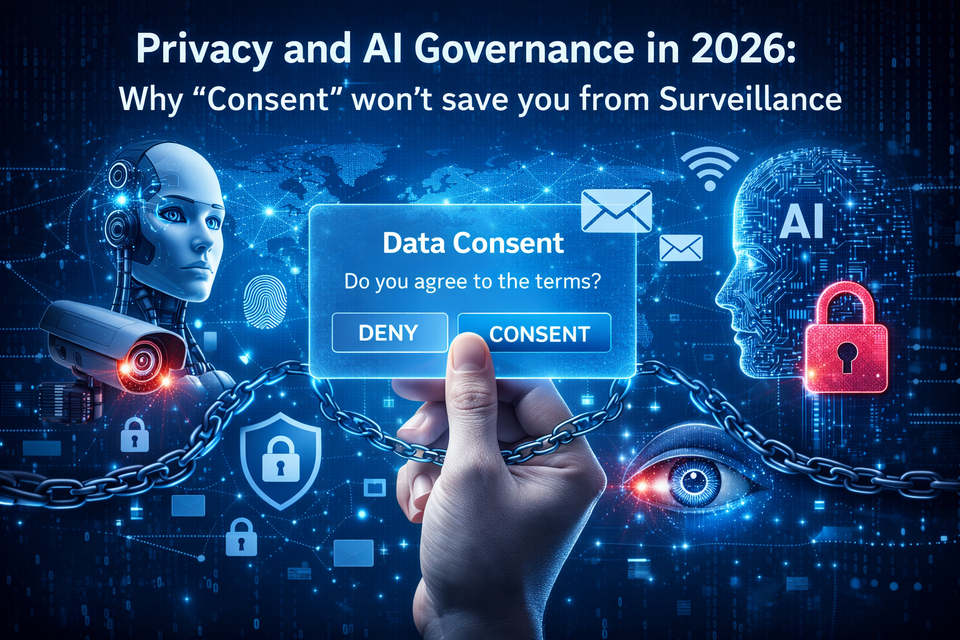
The privacy story people were taught to believe went like this: companies collect data, you click “I agree,” regulators require disclosures, and everyone behaves. In 2026, that story collapses under its own weight.
Not because consent is “bad” in principle, but because modern AI systems turn data into something far more powerful than a single, understandable transaction. AI doesn’t just use what you gave it; it can infer what you didn’t. And when regulators and organizations talk about “AI governance” in 2026, it’s a sign they know consent alone can’t carry the load.
This is the core problem: if surveillance is the default business model, consent becomes a checkbox and not a shield.
The consent myth: you can’t meaningfully agree to what you can’t see
Consent breaks down for three reasons in the AI era:
First, people can’t evaluate the deal. AI data use is rarely one purpose, one dataset, one output. It’s collection, enrichment, feature extraction, model training, fine-tuning, evaluation, monitoring, and reuse often across vendors and toolchains.
Second, consent is exhausted. Even motivated users face constant prompts designed to be accepted quickly. “Choice” becomes a UX obstacle course.
Third, and most important, AI shifts privacy harm from “what you shared” to “what can be inferred.” Even if you never upload a sensitive detail, models and analytics can reconstruct it from correlations (location patterns, device fingerprints, browsing behavior, social graphs, purchase timing). That means your privacy can be undermined even when you “consented” only to something that sounded harmless.
Many privacy and compliance discussions now openly acknowledge this: AI data privacy problems include lack of meaningful consent, excessive data collection, and opaque automated decision-making, plus difficulty enforcing user rights.

AI governance is rising because the stakes are rising
If you’re seeing “AI governance” everywhere, it’s because 2026 is widely expected to be a more consequential year for privacy and AI governance professionals. Meaning less theory and more operational accountability.
Governance sounds boring, but it’s essentially society asking: Who is responsible when AI systems cause harm, and what controls must exist before deployment? That’s not just a paperwork question. It determines whether the next wave of AI expands personal autonomy or quietly normalizes deeper surveillance.
AI governance frameworks consistently treat privacy as central because AI systems often depend on large volumes of sensitive data and create new compliance challenges, especially when used for decision-making.
Europe’s 2026 inflection point: the EU AI Act goes “real”
For privacy-minded users, the single biggest timeline to understand is that the EU’s AI rules move from policy to enforcement reality in 2026.
- The EU AI Act introduces phased compliance timelines, with most provisions taking effect by August 2026.
- Coverage and guidance describe the Act as taking “full effect” by August 2026, applying broadly to companies operating in Europe or serving EU consumers.
This matters because the EU tends to set global defaults. When Europe requires documentation, risk classification, oversight, and controls, multinational vendors often standardize across markets rather than maintain separate “privacy tiers.”
But here’s the catch: even strong regulation won’t automatically reduce surveillance if the underlying incentive remains “collect more data to make models better”. Rules can improve transparency and governance while still leaving the collection machine intact (especially when companies can argue that users “consented”).
The deletion problem: AI makes “right to be forgotten” hard in practice
One of the most revealing stress points is deletion. In a traditional database, deletion is hard but conceptually straightforward. In AI systems, deletion gets weird:
- Was your data used in training?
- Did it influence model weights?
- Did it shape embeddings, clusters, and derived features?
- Are the “insights” generated about you now treated as personal data?
This is why privacy professionals increasingly flag the challenge of applying deletion rights to AI systems trained on personal data and whether AI-generated insights count as personal data.
This is also why “consent” is not enough. Even if you withdraw consent later, can the system actually undo what it learned?
The U.S. posture: “AI dominance” language can sideline privacy
In the U.S., the policy tone around AI has also been shifting. In December 2025, the White House issued an executive order describing a national policy to sustain and enhance U.S. AI dominance through a minimally burdensome framework.
You don’t need to be anti-innovation to see the tension: when “minimally burdensome” becomes the headline, privacy and security often become the fine print. If governance is framed primarily as removing barriers, the practical result can be faster deployment of systems built on maximal data collection, again justified by “consent.”
We got you covered!
We do not require any personals details and you can pay with Bitcoin, Lightning, Monero and other cryptos next to traditional payment methods like PayPal or Credit Card.
Order your service TODAY!
What this means for privacy and anonymity in 2026
One important twist for 2026 is that AI cuts both ways: it supercharges profiling and correlation, but it’s also accelerating a new generation of AI-powered privacy tools (privacy assistants, automated compliance/visibility tools, smarter anti-tracking defenses).
For privacy enthusiasts, 2026 won’t be defined only by whether a new pop-up asks for your permission. It will be defined by whether surveillance becomes infrastructure. Here are some potential shifts to expect:
Privacy harm moves “upstream” into inference
The most consequential privacy violations will increasingly come from prediction and classification, not just disclosure. You may never “share” a trait, but systems can decide you have it and act accordingly.
Anonymity becomes harder because correlation becomes cheaper
Even when you hide your name, AI-driven correlation can stitch identity back together through patterns: timing, writing style, behavior, device signals, and cross-site tracking. “Anonymous” becomes a probability score.
Governance becomes a competitive weapon
Companies will market “trust” while still collecting aggressively because compliance and surveillance can coexist. Users will have to judge privacy by architecture and minimization, not by promises.
Consent won’t save you, only minimization will!
If you want a privacy strategy that survives AI, it has to reduce what’s collected in the first place. Consent should still exist, but it can’t be the foundation.
What works better:
- Data minimization by design: services that can function without building identity dossiers.
- Short retention: data that expires can’t be repurposed forever.
- Local-first and self-hosting where possible: fewer third parties, fewer data flows.
- Hard boundaries on model training: clear commitments about what customer data is never used to train or fine-tune systems.
- Privacy-preserving measurement: analytics that don’t rely on cross-site tracking or fingerprinting.
This is where privacy-first infrastructure providers (including anonymous hosting) matter. Hosting is one of the few layers where you can still choose an environment that isn’t fundamentally built to monetize surveillance.